The ground beneath Hamilton tells two very different stories depending on which side of the river you’re on. Over in Rototuna and Flagstaff, you’re typically dealing with the weathered Hinuera Formation — stiff silts and sands that compacted into decent bearing material millennia ago. Cross the bridge into Bader or Melville, and the profile shifts completely, often revealing soft alluvial clays and pockets of decomposing peat that were laid down when the Waikato River meandered across a much broader floodplain. An exploratory test pit gives you the clearest window into these transitions, exposing the stratigraphy right at the surface so the engineer can see, touch, and log exactly what’s there. In our experience working across Hamilton’s suburbs, there’s no substitute for this hands-on method when you need to map the contact between fill and natural ground before finalising a foundation design. When the upper layers are suspiciously soft, we often recommend pairing the pit investigation with a CPT test to get continuous data on how deep that compressible layer really goes.
In Hamilton’s peat-affected suburbs, what you don’t see at the bottom of the test pit is often more critical than what you do.
Methodology applied in Hamilton
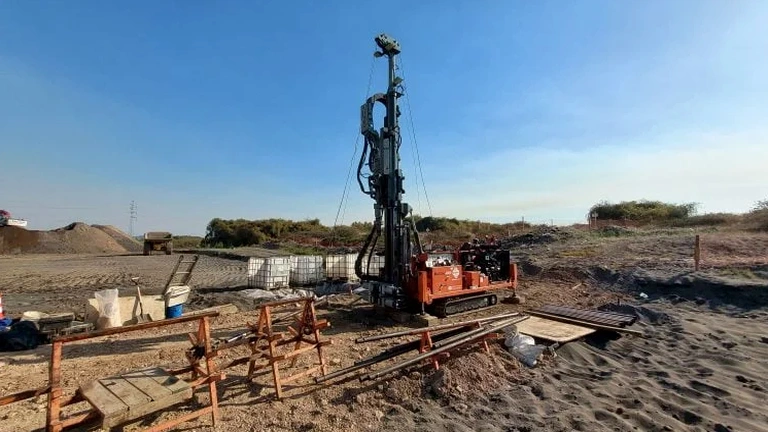
Typical technical challenges in Hamilton
NZS 4404:2010 sets out the requirements for land development and subdivision earthworks, and it places a heavy emphasis on identifying unsuitable material before a single foundation is poured. In Hamilton, this isn’t a theoretical exercise. The city sits on a patchwork of drained swamp deposits, and the difference between a competent Hinuera silt and a compressible organic clay can be just a few metres laterally. An exploratory test pit that misses an old farm drain backfilled with saturated topsoil — something we’ve encountered more than once in the older sections of Claudelands — creates a direct path to differential settlement and a very unhappy homeowner. The pit also serves as the primary reference for the earthworks specification: it’s where the supervising engineer confirms the actual cut/fill interface and validates the pre-construction assumptions about groundwater. Getting this wrong in Hamilton means the risk isn’t just structural; it’s the cost of dewatering a subdivision that should have been redesigned after the first pit was opened.
Our services
Our exploratory test pit work in Hamilton is built around giving the design team direct, unambiguous information about the upper soil profile. We run the investigation from first dig to final lab correlation so nothing gets lost between the field and the report.
Machine-Excavated Test Pits with Geotechnical Logging
Full-profile logging by an experienced engineering geologist with real-time field classification including pocket penetrometer and shear vane readings. We photograph every face and log changes in moisture, colour, and consistency across the depth of the excavation.
In-Situ Sampling and Groundwater Documentation
Collection of undisturbed block samples, bulk bags for laboratory classification, and sealed tube specimens where wall stability allows. We record the exact depth of any groundwater seepage and monitor the rate of inflow over the time the pit remains open.
Common questions
How deep can an exploratory test pit go in Hamilton’s soils before shoring is required?
Under the Health and Safety at Work Act and good practice guidelines, any pit deeper than 1.5 metres requires either benching, battering, or shoring. In Hamilton’s Hinuera Formation silts, the walls often stand well enough for a short period, but we always assess the stability before anyone enters. When we need to go beyond 2.5 metres through softer alluvial material, we typically batter the sides back or switch to a different investigation method to keep the team safe.
What does an exploratory test pit reveal that a borehole misses?
A test pit exposes a continuous vertical face, so you can see thin lenses of sand, organic seams, and old buried topsoil layers that a borehole log might skip right past. You also get a true picture of the soil fabric and structure — things like fissuring in the clay or the exact contact angle between fill and natural ground — which are nearly impossible to interpret from disturbed cuttings alone.
How much does an exploratory test pit investigation cost in Hamilton?
Do you need a resource consent or traffic management plan to open a test pit on a residential section in Hamilton?
For a straightforward pit on private property, resource consent is rarely required. However, if the excavation is within the road reserve or the site has specific overlays in the District Plan, we coordinate with Hamilton City Council early. If the pit is near the boundary, we also check for service locations to avoid any surprises with buried infrastructure.
Can you take samples from the test pit for laboratory strength or consolidation testing?
Yes, and this is one of the biggest advantages of the method. We carefully trim and seal undisturbed block samples from the pit wall, which gives the lab a far better specimen than a disturbed bag sample. For Hamilton’s soft clays and peats, these blocks let us run accurate consolidation and undrained shear strength tests that directly inform the settlement and bearing capacity calculations.