A common mistake on Hamilton sites is assuming the gentle topography means you can skip a proper slope stability assessment. The ground around here can be deceptive. You strip back the topsoil and find soft pumice silts or thick peat lenses that lose strength the moment they’re unloaded, and suddenly a straightforward basement cut turns into a creeping failure. We’ve seen it happen on the river terraces more times than you’d expect. To avoid that kind of surprise, our team runs the full investigation sequence: drilling for undisturbed samples, logging the stratigraphy against the NZGS guidelines, and feeding the data into limit-equilibrium models. When the cut is near existing infrastructure, we pair the analysis with excavation monitoring to track real-time displacements, which gives the contractor confidence to keep the programme moving without triggering a Worksafe notification.
Factor of safety is just a number until you know which failure mechanism actually controls the slope—and in Hamilton’s layered ash soils, it’s rarely the one you first assume.
Methodology applied in Hamilton
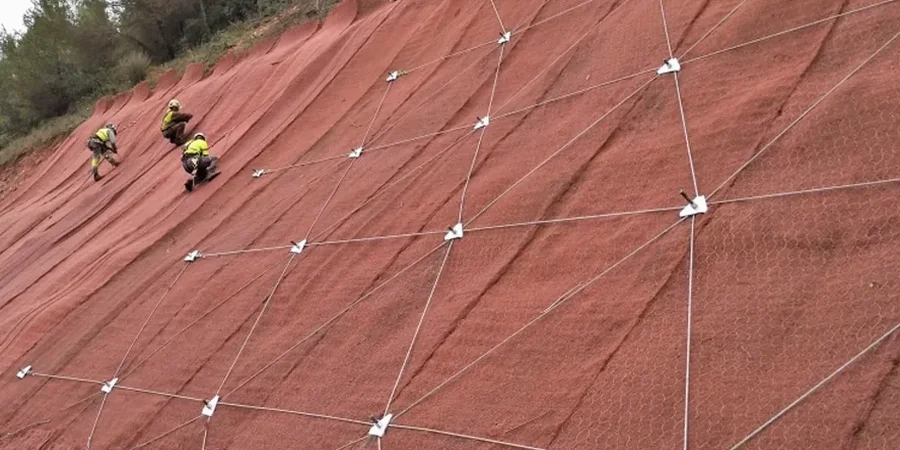
Typical technical challenges in Hamilton
NZS 3404 and the NZGS guidelines don’t leave much room for guesswork when it comes to cut slopes in the Waikato. The trigger for a detailed stability check is actually quite low—any permanent cut deeper than 2 metres within 5 metres of a boundary or public asset, or any fill placed on a slope steeper than 1V:4H. Hamilton’s particular problem is the Hinuera Formation ignimbrite-derived silts that can hold a near-vertical face for weeks after excavation, then collapse without warning when suction dissipates. That time-dependent behaviour catches out crews who are used to North Island greywacke. A test pits programme often reveals the critical stratigraphy early, especially where fill has been placed over peat pockets along old gullies—and those pockets are exactly where the circular failure surfaces initiate.
Our services
A slope stability assessment in Hamilton typically employs multiple investigation methods, as no single test can provide a complete understanding. The following three services are most frequently utilised for Waikato projects.
Rotary and hollow-stem auger drilling for shear strength sampling
We drill through the Hamilton Ash and into the underlying alluvium to recover undisturbed tube samples. The lab then runs multistage CU triaxial and direct shear to define the Mohr-Coulomb envelope for each distinct unit.
Piezometer installation and groundwater monitoring
Standpipe or vibrating-wire piezometers are installed at critical depths to track seasonal pore-pressure changes. We use the data to calibrate the ru values in the limit-equilibrium model, which often makes the difference between a passing and failing slope.
Limit-equilibrium modelling with back-analysis
We build the cross-section in Slide2 or Slope/W, assign the lab-measured strengths, and run circular and non-circular searches. If there is an existing failure, we back-analyse it to calibrate the model before applying it to the proposed geometry.
Common questions
What does a slope stability analysis cost for a typical residential section in Hamilton?
Can you use CPT instead of drilling for a slope stability analysis?
We use CPT extensively in the Waikato, and it’s excellent for picking up thin peat seams and tracking the undrained strength profile. But for a slope that relies on effective-stress parameters, we still need at least one borehole to recover tube samples—CPT gives you undrained strength, not the drained friction angle you need for long-term stability.
What is the minimum factor of safety Hamilton City Council generally accepts?
Hamilton City Council follows the NZGS guidance, which recommends a minimum static factor of safety of 1.5 for permanent slopes. For the seismic case, a factor of 1.1 to 1.2 is typical, but the exact value depends on the site subsoil class from NZS 1170.5 and the consequence of failure.