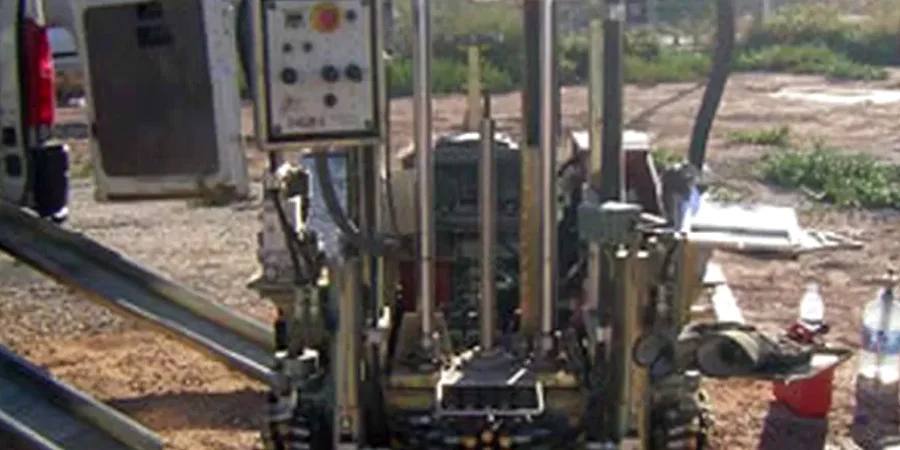
The rig arrives on a compact crawler carrier. A 20-tonne thrust mechanism drives a conical probe into the ground at a constant 20 mm/s. No boreholes. No cuttings. Just continuous data streaming from the tip. In Hamilton, where the Waikato River has laid down sequences of soft alluvial silts, organic peat, and loose pumice sands, this method cuts through the stratigraphy faster than any conventional drill. The cone registers three parameters simultaneously: cone tip resistance (qc), sleeve friction (fs), and dynamic pore water pressure (u2). Our lab team processes the raw voltage signals through calibrated transducers, applying baseline corrections derived from saturation checks at the start of every push. The result is a near-continuous soil behavior type profile. For sites near the riverbank where peat layers exceed 3 meters, the CPT provides the stratigraphic resolution that SPT blow counts simply cannot capture.
In Hamilton's peat basins, the CPT measures what the SPT misses—continuous pore pressure dissipation rates that determine how long a foundation will settle.
Methodology applied in Hamilton
Typical technical challenges in Hamilton
A warehouse extension on Te Rapa Road encountered a 4-meter-thick peat lens at 2 meters depth. The standard SPT returned zero blows for the entire interval. The contractor assumed uniform soft ground and proposed a simple raft foundation. We mobilized the CPT rig the next morning. The cone tip resistance dropped to 0.08 MPa through the peat, but the friction ratio spiked above 5%, confirming highly compressible organic material. More critically, the pore pressure dissipation test showed a t50 of 45 minutes. That slow consolidation rate meant the peat would settle for years under structural load. The structural engineer switched to driven timber piles socketed into the dense Taupo Pumice Alluvium below. Total settlement was reduced to less than 8 mm. Without the CPT, the differential settlement would have cracked the slab within the first wet season. In Hamilton's river terraces, ignoring the organic layers is a direct path to structural distress.
Our services
CPT operations in Hamilton require careful planning around access constraints and subsurface variability. We provide two core service configurations.
Standard Piezocone (CPTu) Profiling
A single 10 cm² cone with a saturated pore pressure element. We push to refusal or target depth, recording qc, fs, and u2 at 10 mm intervals. The resulting log identifies peat layers, loose pumice sands, and the top of the Hinuera gravels. Dissipation tests at selected depths measure consolidation characteristics directly.
Seismic CPT (SCPTu) for Site Class Determination
A triaxial geophone module behind the standard cone measures shear wave velocity (Vs) at 1-meter intervals during brief pauses in penetration. The Vs profile defines the site class per NZS 1170.5, critical for seismic design in Hamilton's Class C and D soils. We correlate the Vs data with the cone tip resistance to refine the small-strain stiffness profile for dynamic analysis.
Common questions
What does a CPT test cost for a typical residential section in Hamilton?
How many CPT pushes are needed for a commercial building site?
Hamilton’s variable alluvial stratigraphy typically requires a grid spacing of 15 to 25 meters. For a 500 m² commercial footprint, we recommend a minimum of three pushes forming a triangle, plus one additional push near any suspected peat hollow. This density captures lateral transitions between Hinuera Formation terraces and recent floodplain deposits.
Can the CPT penetrate the dense Hinuera gravels?
Refusal often occurs when the cone hits the top of the Hinuera Formation gravels, typically at tip resistances exceeding 40 MPa. We monitor the thrust load continuously and stop before rod buckling. In such cases, we combine the CPT with a single machine-drilled borehole through the gravels to confirm the refusal material and allow sampling.
How long does a CPT push take?
A 15-meter push in Hamilton’s soft silts and peat takes roughly 12 to 15 minutes of continuous penetration. Adding three dissipation tests of 30 minutes each brings the total field time to about two hours per location. The SCPTu variant adds approximately 20 minutes per push for the shear wave measurements at each meter interval.
What is the difference between CPT and SPT for foundation design?
The SPT gives a blow count every 1.5 meters with significant disturbance. The CPT gives a near-continuous profile of tip resistance, sleeve friction, and pore pressure. In Hamilton’s interbedded peat and pumice, the CPT identifies a 200 mm organic seam that the SPT would miss entirely. For settlement calculations, the CPT dissipation test provides a site-specific coefficient of consolidation rather than an estimated value from index tests. More info.