In-situ testing forms the backbone of reliable geotechnical site investigation across Hamilton, encompassing a range of field-based methods that assess soil and substrate properties directly in their natural state without disturbing sample integrity. This category covers essential techniques such as cone penetration testing, standard penetration testing, vane shear testing, and nuclear density gauging, each providing critical data on bearing capacity, compaction levels, and stratification. In a city experiencing rapid residential and commercial expansion into areas like Rotokauri and Peacocke, understanding ground conditions before construction begins is not only prudent but often mandatory under the Building Act 2004. The value of these tests lies in their ability to deliver immediate, representative data that laboratory testing alone cannot replicate, especially in Hamilton's variable alluvial and peat-rich terrains.
Hamilton's subsurface conditions are heavily influenced by the Waikato River and its historic floodplains, which have deposited layers of soft alluvial silts, organic soils, and peat across much of the urban footprint. These materials present significant challenges for foundation design, particularly the highly compressible peat lenses that can extend several metres deep in areas such as Bader and Melville, leading to differential settlement if not properly identified. The Hinuera formation, a sequence of pumiceous sands and gravels, also underlies parts of the city and can behave variably under load depending on density and saturation. In-situ testing is therefore indispensable for mapping these discontinuous soft spots and assessing liquefaction potential, a concern heightened by New Zealand's seismic setting even in the Waikato region.
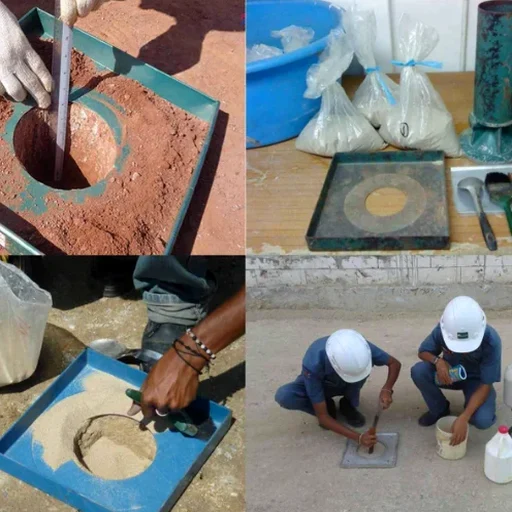
New Zealand's regulatory framework for in-situ testing is governed primarily by NZS 4402 (Methods of Testing Soils for Civil Engineering Purposes) and the New Zealand Geotechnical Society's guidelines, which align with international standards such as ASTM and ISO where applicable. For field density determination, the field density test (sand cone method) follows NZS 4402:1986 Test 5.2.1, specifying procedures for measuring in-place dry density of compacted soils—a critical control for earthworks compliance in subdivision and roading projects. The Building Code clause B1 (Structure) demands that foundations be designed for the specific site conditions, effectively requiring in-situ assessment whenever ground is suspect, while the Resource Management Act 1991 triggers geotechnical investigation for any significant land disturbance or development.
Projects ranging from single-dwelling foundations on peat-affected sections to large-scale infrastructure such as the Peacocke arterial roading network depend on in-situ testing to validate design assumptions and ensure long-term performance. Commercial developments in the Hamilton CBD, where deep alluvial deposits necessitate piled foundations, rely on cone penetration testing to profile strata and estimate pile capacities without excessive conservatism. Similarly, industrial subdivisions in the Te Rapa area require rigorous compaction verification using nuclear densometer testing or the sand cone density test to meet council consent conditions. Agricultural and stormwater pond construction also benefit from in-situ permeability testing to confirm liner integrity and prevent leakage into underlying aquifers.
Available services
Common questions
What types of in-situ tests are most commonly required for residential developments in Hamilton?
Residential projects on Hamilton's peat and alluvial soils typically require Scala penetrometer testing to assess bearing capacity and identify soft layers, combined with hand shear vane tests for undrained strength in cohesive soils. For larger subdivisions, dynamic cone penetration tests and sand cone density tests for fill compaction verification are standard, with CPT rigs deployed where deeper profiling is needed.
How do Hamilton's peat soils affect in-situ testing procedures and results?
Peat layers compress significantly under load and exhibit high water content, causing conventional penetration tests to underestimate strength unless corrections are applied. In-situ testing in peat zones often requires specialised equipment like ball penetrometers or field vane tests with larger blades, and results must be interpreted cautiously to account for secondary compression and long-term settlement potential.
What New Zealand standards govern in-situ testing methods?
NZS 4402 provides the primary suite of standards covering field tests including cone penetration (Test 6.5.1), vane shear (Test 6.2.1), and density determination via sand cone (Test 5.2.1). The New Zealand Geotechnical Society publishes supplementary guidelines, while NZS 1170.5 informs seismic site classification often derived from in-situ shear wave velocity measurements.
When is in-situ testing required instead of or alongside laboratory testing on a Hamilton site?
In-situ testing is mandated when soil disturbance during sampling would alter key properties, such as density, strength, or permeability, which is common in Hamilton's sensitive silts and loose pumiceous sands. It complements laboratory work by providing continuous profiling and immediate data for construction verification, and is essential where peat or soft alluvium makes undisturbed sampling impractical.