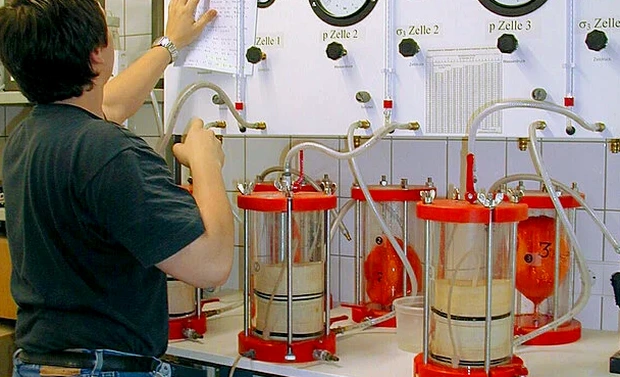
The CBR press in our Hamilton laboratory is a 50 kN capacity loading frame equipped with a 50 mm penetration piston, twin dial gauges, and a controlled strain rate of 1.27 mm per minute, exactly as specified in NZS 4402:1988. Samples arrive from sites across the Waikato basin—Te Rapa industrial subdivisions, Peacockes greenfield developments, and rural road upgrades near Gordonton—where the subgrade often contains volcanic ash layers from the Hamilton Ash Formation. Each specimen is compacted at optimum moisture content determined by a companion Proctor test, then submerged for 96 hours to simulate the worst-case saturation scenario that Waikato clay soils experience during winter. Load-penetration curves are plotted in real time, and the ratio to standard crushed stone resistance yields the CBR value that pavement engineers use directly in layer thickness calculations.
A 96-hour soaked CBR on Hamilton Ash Formation clay will typically yield less than half the unsoaked value—design pavement thickness on the soaked number or risk premature rutting.
Methodology applied in Hamilton
Typical technical challenges in Hamilton
Hamilton sits at approximately 40 meters above sea level on the floodplain of the Waikato River, and much of the city's expansion—particularly in Rotokauri and Burbush—occurs on peat bogs and soft alluvial silts with CBR values below 3%. Designing a pavement structure for CBR 3 versus CBR 10 doubles the required aggregate thickness, which on a 2-kilometre residential subdivision translates to thousands of extra cubic metres of imported fill. The 2016 Kaikōura earthquake sequence, though distant, prompted NZTA to tighten deflection criteria on state highways, and a reliable CBR input became mandatory for mechanistic-empirical design in the Waikato. When a subgrade returns soaked CBR under 5%, we routinely recommend evaluating subgrade improvement with stone columns or lime stabilisation before any pavement layer is placed, because the cost of remediation post-construction in Hamilton's high-water-table conditions is punitive.
Our services
The laboratory CBR test constitutes one element of a comprehensive pavement investigation programme. The subsequent services are customarily requested in conjunction for Waikato roading and earthworks projects:
Soaked CBR (NZS 4402)
The full 96-hour submerged test with swell measurement and load-penetration recording at 2.5 mm and 5.0 mm. The standard method for all NZTA-funded pavement designs.
Unsoaked CBR for Select Fill
Immediate CBR determination on compacted specimens without soaking. Used for imported hardfill verification where saturation is not expected.
CBR on Cement-Stabilised Materials
Modified procedure with 7-day curing at constant moisture before soaking. Evaluates strength gain from cement or lime treatment of marginal subgrades.
Combined CBR and Swell Potential
Extended monitoring during the 96-hour soak to quantify vertical swell, reported alongside the CBR value. Critical for Hamilton Ash and allophane soils.
Common questions
What is the difference between field CBR and laboratory CBR?
Field CBR is measured directly on the subgrade surface using a dynamic cone penetrometer (DCP) or a field loading plate, without removing the soil from its in-situ moisture and density condition. Laboratory CBR requires sampling, remoulding at a specified compactive effort and moisture content, and a 96-hour soaking period. The laboratory value represents the material's potential strength under controlled compaction, while the field value reflects the actual condition at the time of testing. For design purposes, NZTA and Austroads require the soaked laboratory CBR as the design input.
How much does a laboratory CBR test cost in Hamilton?
Why does the CBR specimen need to be soaked for four days?
The 96-hour soaking period, mandated by NZS 4402, simulates the worst-case moisture condition a pavement subgrade will experience over its service life. In Hamilton, the water table is shallow—often within 1.5 metres of the surface in winter—and prolonged saturation reduces the strength of volcanic ash soils and alluvial silts dramatically. A test performed without soaking would overestimate the subgrade strength and lead to under-designed pavement thickness, which manifests as rutting and cracking within the first few years of traffic loading.