Hamilton sits near the centre of the Waikato Basin, roughly 40 metres above sea level, and its subsurface tells a story of ancient river sediments and peat layers. The city has felt the rumble of multiple events, including the 1987 Edgecumbe earthquake, reminding engineers that distance from a plate boundary does not equal immunity. For critical facilities on these compressible deposits, a conventional fixed-base design can amplify drift and damage non-structural components. Base isolation seismic design changes the equation by decoupling the superstructure from ground motion. We apply this approach to new builds and retrofits across the city, filtering the seismic energy before it enters the structural frame. A proper isolation strategy in Hamilton must account for the basin’s amplification effects, which is why we pair the design phase with a seismic microzonation study to capture site period characteristics. We also run MASW surveys to measure shear-wave velocity profiles down to 30 metres, feeding the VS30 value directly into the Site Class determination per NZS 1170.5.
A well-tuned isolation system on Waikato Basin soils can cut spectral acceleration demands by over 60 percent compared to a fixed-base code design.
Methodology applied in Hamilton
Typical technical challenges in Hamilton
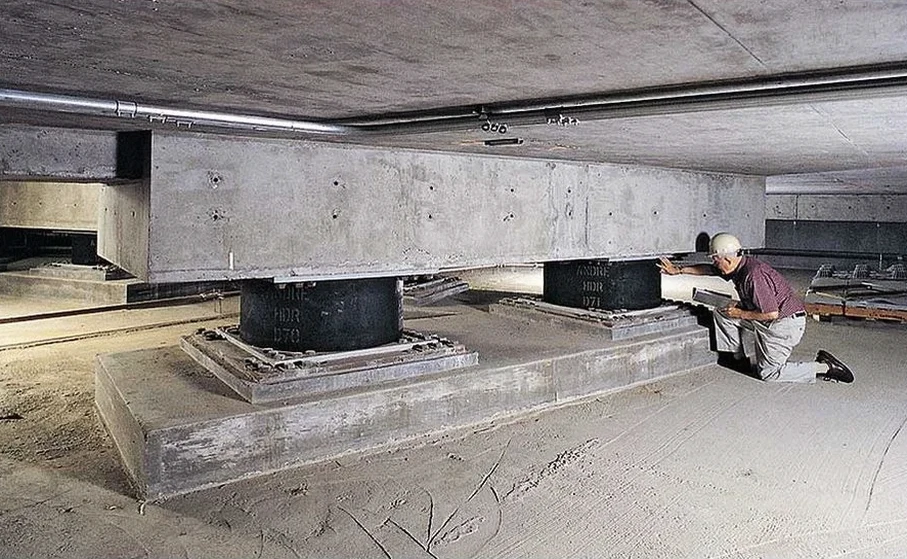
A recurring issue we see in Hamilton is the assumption that an isolation system designed for firm ground in Auckland or Christchurch will perform identically here. Basin-edge effects and the Waikato’s deep soft soil profile produce longer-duration shaking with significant spectral content at periods above 1.5 seconds — precisely where an isolator’s resonant frequency sits. Without a site-specific hazard analysis, the isolator displacement demand can be underestimated by more than 30 percent. Another risk is ignoring the moat wall detail; we have reviewed designs where the seismic gap was sized for the design basis earthquake but became insufficient under the MCE, leading to pounding and force transfer back into the structure. Differential settlement of the foundation raft under sustained gravity load plus cyclic rotation of the bearings is another failure mode that must be checked against the compressible Hamilton soils. A solid peer review of the isolation design and the supporting geotechnical model is not optional.
Our services
Base isolation design in Hamilton demands close coordination between structural and geotechnical disciplines. Our service package covers the full workflow from concept to commissioning.
Isolation System Design & Modeling
Nonlinear time-history analysis of isolated structures using site-specific ground motions scaled to the NZS 1170.5 hazard spectrum. Bearing selection, moat wall detailing, and displacement restraint design for the Waikato soil profile.
Full-Scale Bearing Testing
Prototype and production testing of elastomeric and sliding isolators under combined axial, shear, and rotational loading in our accredited laboratory, following ISO 22762 and project-specific control parameters.
Geotechnical Site Characterisation
Integrated MASW, CPT, and borehole campaigns to define the Site Class, VS30, liquefaction potential, and dynamic soil properties required for the soil-structure-isolation interaction model.
Common questions
What makes Hamilton’s soil conditions relevant for base isolation design?
Much of central Hamilton sits on the Hinuera Formation and overlying alluvium — a mix of silts, sands, and organic clays that amplify long-period ground motion. This basin effect means the spectral acceleration at isolation periods (2–3 seconds) can be higher than a generic rock-site model predicts, directly affecting isolator displacement and the required moat width.
How is the isolation system tested before installation?
We conduct prototype tests on at least two full-scale bearings per type, applying three fully reversed cycles at increasing shear strain amplitudes up to the Maximum Considered Earthquake displacement. Production testing then verifies every bearing meets the stiffness and damping acceptance criteria defined in the project-specific test plan.
Which New Zealand standards govern base isolation design?
The primary earthquake action standard is NZS 1170.5:2004, with structural steel elements complying with NZS 3404. Internationally recognised standards such as ISO 22762 for elastomeric isolators and ASCE 7-16 Chapter 17 for analysis and testing are also adopted in our design methodology.