The excavator bucket curls through the topsoil near Hamilton Lake, revealing that familiar sequence of alluvial silts and the dark, fibrous peat lenses that define so much of the Waikato Basin. From our mobile laboratory parked on a River Road subdivision, the conversation inevitably turns to lateral earth pressures and how the retained height interacts with a compressible layer at depth. Hamilton’s Quaternary geology, shaped by the ancestral Waikato River meandering across the floodplain, demands retaining wall designs that go well beyond textbook assumptions. A standard cantilever detail copied from an Auckland volcanic site simply does not translate here; the peat’s secondary consolidation and the sensitivity of the Mangaotama silts require a design response calibrated to local stratigraphy. We rely on thorough ground investigation and laboratory testing to establish the drained and undrained parameters that feed directly into the wall geometry, reinforcement schedule, and drainage specification.
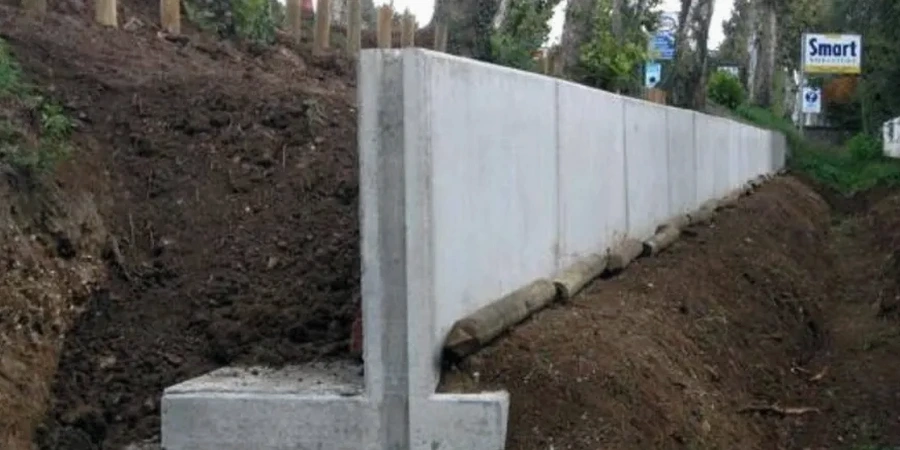
Designing a retaining wall in Hamilton means mastering the interplay between peat compressibility and the drained strength of river terrace gravels.
Methodology applied in Hamilton
Live process video
Typical technical challenges in Hamilton
A five-storey mixed-use development on Ulster Street had excavated to full depth when the contractor noticed a 4 mm crack opening at the crest of the temporary batter, right where the geotechnical model had predicted the tension crack zone above a buried peat channel. The design team had flagged this exact scenario during the consenting phase, and because the permanent retaining wall had already been designed with a deep shear key and a sub-horizontal drain array penetrating the peat contact, the permanent works proceeded without redesign delay. This episode underscores the risk in Hamilton of misinterpreting the undrained behaviour of the organic soils during construction; a short-term excavation that stands safely in desiccated summer conditions can rapidly degrade when winter rainfall saturates the upper crust. Our approach mandates rigorous construction-phase monitoring and a design that accounts for the worst-case pore pressure profile, ensuring that the long-term wall performance is not compromised by a transient groundwater event.
Our services
Retaining wall design in Hamilton extends well beyond the structural section; we deliver a complete geotechnical package that ties the ground model to the construction sequence.
Geotechnical investigation for retaining walls
Cone penetration testing, machine boreholes, and test pits to map the peat thickness, gravel depth, and groundwater regime specific to your Hamilton site, feeding directly into the wall design parameters.
Structural design and PS1/PS2 documentation
Preparation of Producer Statements (PS1 design and PS2 review) in accordance with Hamilton City Council consenting requirements, supported by detailed calculations for all wall components including stem, base, key, and drainage.
Common questions
What is the typical cost range for retaining wall design in Hamilton?
How does the Waikato peat affect retaining wall stability?
The peat layers common across Hamilton compress significantly under surcharge and exhibit low undrained shear strength. This combination can trigger deep-seated rotational failures that bypass the wall entirely. Our designs always include a global stability check that models the peat as a distinct, low-strength horizon, and we specify drainage measures to prevent pore pressure build-up at the peat interface.
Do I need a resource consent for a retaining wall in Hamilton?
Under the Hamilton City District Plan, a retaining wall over 1.5 metres in height or located within a yard setback generally requires a building consent, and in some cases a resource consent if it affects overland flow paths or is near a boundary. We guide clients through the consent pathway, preparing the geotechnical and structural documentation that the Council reviewers expect. More info.