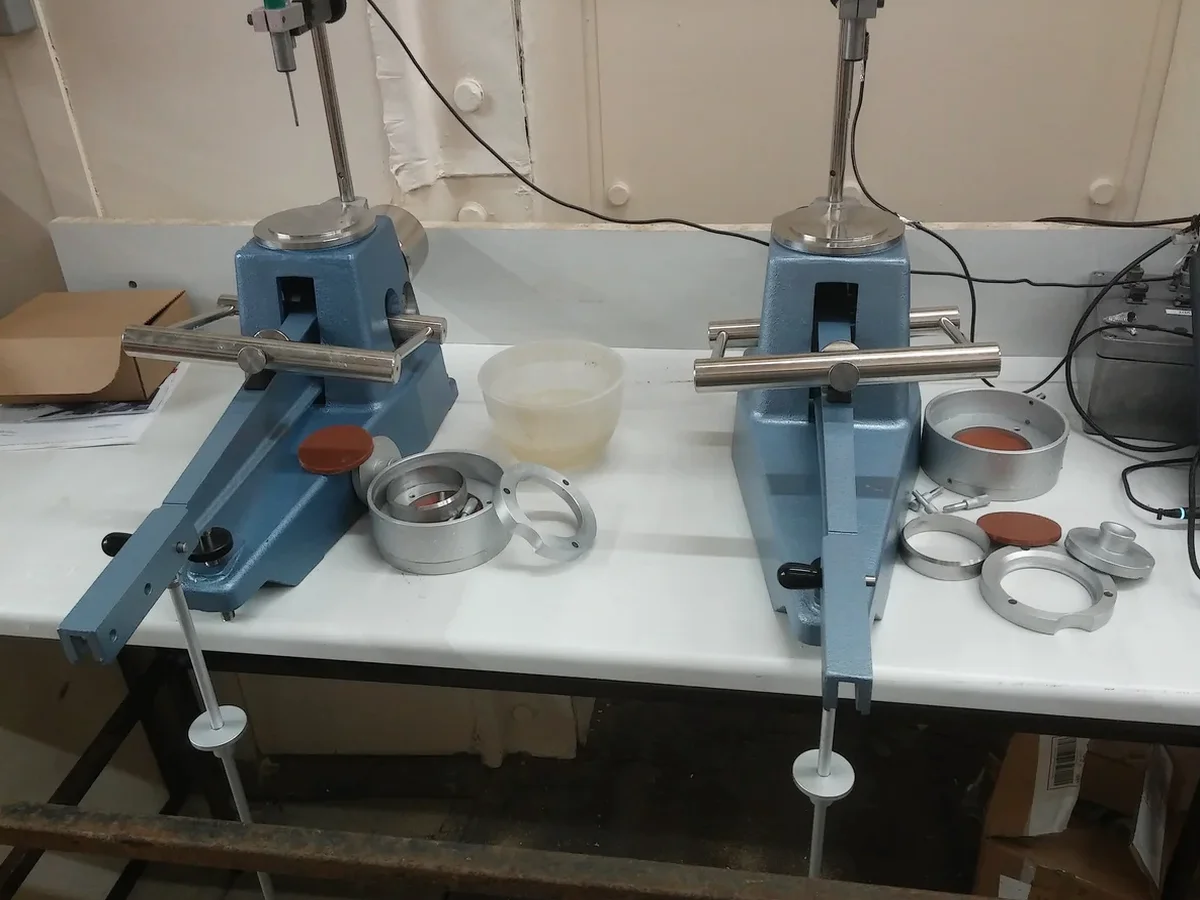
When a site investigation in Hamilton stretches across the floodplains of the Waikato River, you quickly learn that visual classification alone won't cut it. The river-deposited silts and weathered ash layers that blanket much of the city can shift behavior dramatically with just a small change in moisture. The Atterberg limits test pins down exactly where those transitions happen. Our lab runs the liquid limit using the Casagrande cup method and the plastic limit by thread-rolling, both following NZS 4402 procedures. For projects near the peat pockets around Rototuna or the sensitive clays in the north, we often pair this with a grain-size analysis to separate the fine fraction properly, and a triaxial test if the loading conditions demand effective stress parameters. The numbers don't lie: a plasticity index above 20 in Hamilton means you need to account for significant volume change.
A plasticity index above 20 in Waikato soils signals a reactive clay that will move with the seasons. Knowing that number before you pour a foundation saves tens of thousands in remedial work.
Methodology applied in Hamilton
Live process video
Typical technical challenges in Hamilton
A medium-rise apartment building on Ulster Street was founded on what the borelogs called 'firm brown clay.' The Atterberg limits came back with a liquid limit of 72 and a plasticity index of 41. That is not just clay: it is a highly reactive soil that will shrink enough in a dry summer to open cracks in a stiffened raft, then swell in winter and lift the corners. The design was revised to include a suspended floor over a ventilated void, and the foundation depth was pushed down to 1.8 meters to get below the active zone. Without those three numbers from the Atterberg test, the structural engineer would have signed off on a slab that would not have lasted five years in Hamilton's climate. The test itself is inexpensive relative to what it protects, which is why we recommend it on every borehole sample where the fines content exceeds 35 percent.
Our services
Our Hamilton laboratory runs the full Atterberg limits suite on samples collected by our drilling crews or submitted by external consultants. Turnaround is typically three to four working days, with rush processing available for active construction sites.
Standard Atterberg Limits
Liquid limit, plastic limit and plasticity index on a single remolded sample. Includes USCS classification and a brief interpretive note on expected shrink-swell behavior.
Full Shrink-Swell Assessment
Atterberg limits plus linear shrinkage and a companion particle size distribution. Delivers the reactivity classification needed for NZS 3604 foundation design.
Multi-Level Profiling
Atterberg tests at 1.0 m depth intervals down a borehole to map the active zone. Common for larger residential subdivisions and commercial slabs on grade.
Correlation & Reporting Package
Data tabulation with liquidity index, activity, and comparison against regional Waikato soil databases. Useful for geotechnical peer review and consent documentation.
Common questions
How much does Atterberg limits testing cost in Hamilton?
How long does the test take from sample drop-off to report?
The standard turnaround is three to four working days. The test itself requires overnight oven drying, so same-day results are not possible, but we can prioritize the reporting once the drying and weighing are complete if the site schedule is tight.
What soil types in Hamilton most need Atterberg limits testing?
The alluvial clays along the Waikato River corridor, the weathered Hinuera Formation silts, and the volcanic ash-derived soils that appear across the city are all candidates. Any sample where the fines content exceeds 35 percent should be tested because the plasticity can vary widely over short distances.
Can I use Atterberg limits by themselves to classify a foundation site?
The limits give you the plasticity and shrink-swell potential, but a complete foundation assessment under NZS 3604 also needs the undrained shear strength from a pocket penetrometer or unconfined compression test, plus the profile depth information from the borehole log. The Atterberg numbers are one critical piece of that puzzle.