A common oversight among contractors working across Hamilton’s southern growth corridors is treating a vibro-replacement specification as a simple gravel backfill operation without verifying column stiffness against the surrounding peat matrix. When the modulus contrast between the stone column and the Waikato peat falls below the threshold needed for stress concentration, the composite ground still settles excessively under embankment loading, often triggering differential movement that cracks pavement within two years of handover. Our laboratory team runs full particle-size distribution and Proctor compaction curves on the proposed backfill stone before a single vibrator is mobilised, because column performance in Hamilton’s organic silts depends as much on aggregate angularity and fines content as it does on probe diameter. Complementing this with CPT testing before and after installation gives us a direct measurement of the improvement ratio, removing the guesswork from modulus assumptions that too often lead to post-construction disputes.
A stone column in Hamilton peat works as a stiff inclusion, not a pile. Getting the stiffness ratio right demands laboratory-measured compressibility of the organic layer, not textbook assumptions.
Methodology applied in Hamilton
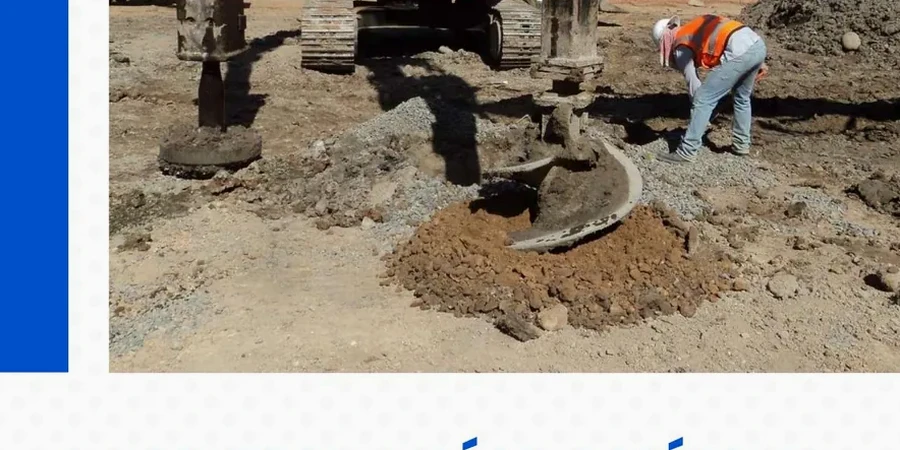
Typical technical challenges in Hamilton
Hamilton’s temperate maritime climate, with its 1,100 mm of annual rainfall distributed evenly across the year, keeps the near-surface peat layers close to saturation even during summer months, which means the undrained shear strength governing column installation is frequently lower than what a dry-season site investigation would suggest. When a vibrator penetrates fully saturated fibrous peat with undrained strengths below 12 kPa, the risk of excessive lateral bulging and incomplete column formation rises sharply unless the installation sequence is staged to allow partial pore pressure dissipation between adjacent columns. Post-treatment monitoring with in-situ permeability testing verifies that the drainage path to the columns remains functional after smearing, a detail that is easy to overlook but critical for long-term consolidation performance under sustained floor loads.
Our services
Our Hamilton ground improvement work covers the full sequence from laboratory characterisation through to post-installation verification, all under a single quality management system. Each phase feeds directly into the next so the design assumptions are validated with data from the same site, not borrowed from a regional database.
Design Unit Cell Analysis
We compute settlement reduction factors and stress concentration ratios using site-specific compressibility and strength parameters from oedometer and triaxial tests on undisturbed samples, delivering a column grid and depth schedule optimised for your allowable total and differential settlement limits.
Backfill Aggregate Qualification
Full laboratory programme including particle-size distribution (sieve analysis), Los Angeles abrasion, flakiness index, and modified Proctor compaction testing to confirm the proposed stone meets the minimum friction angle and permeability requirements for long-term column drainage.
Post-Installation Verification Testing
CPT profiling on a grid covering both column centres and inter-column zones, plus zone load testing where specified, to quantify the improvement ratio and confirm that the treated ground achieves the design modulus prior to structural construction.
Common questions
How much does stone column design and testing cost for a typical Hamilton residential subdivision?
Why is laboratory testing of the backfill stone important for Hamilton peat sites?
Hamilton peat has very low lateral confinement, so the stone column carries load through internal friction and dilatancy. If the backfill contains excessive fines or lacks angularity, the friction angle drops and the column compresses more than the design assumes. Our lab measures gradation, particle shape, and compaction characteristics to confirm the stone will achieve the target modulus under the confining stress available in the peat.
What verification is required after stone column installation under NZGS guidelines?
NZGS guidelines recommend a combination of CPT soundings at column centres and inter-column locations to compute the improvement ratio, plus zone load tests on larger projects to validate the composite modulus. The testing grid density is tailored to the variability of the ground and the consequence class of the structure.
Can stone columns be used for liquefaction mitigation beneath Hamilton structures?
Yes, where the potentially liquefiable layer is within the depth reachable by the vibrator. The densification effect reduces the cyclic shear strain potential, and the columns provide drainage paths that limit pore pressure build-up. We pair the column design with a site-specific liquefaction assessment using CPT-based triggering analysis to confirm the residual factor of safety meets the requirements of the Building Code.