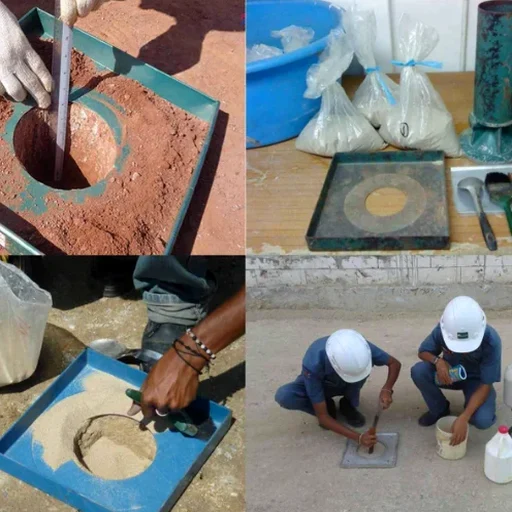
The alluvial silts and clay loams that define Hamilton's Waikato River flats demand precise compaction control during bulk earthworks. Beneath the surface, localized peat lenses and variable moisture content can undermine structural fill if left unchecked. The sand cone method, governed by NZS 4404:2010, remains the definitive field test for verifying in-place dry density against the project's Proctor tests target. One practical advantage in the Hamilton basin is speed -- a single test can be completed in under 30 minutes, providing real-time feedback to the compactor operator. For deeper verification where imported granular fills exceed 600 mm, the density log can be paired with CPT test profiling to correlate surface readings with subsurface consistency, particularly near the riverbank suburbs of Claudelands and Hamilton East.
A 1% drop in relative compaction below 95% Standard Proctor can reduce the resilient modulus of a subgrade by over 10%, amplifying long-term pavement fatigue.
Methodology applied in Hamilton
Live process video
Typical technical challenges in Hamilton
A routine platform fill job on Peachgrove Road encountered a 300 mm lens of desiccated peat at formation level. The contractor proof-rolled and passed visual inspection, but the first three sand cone tests returned relative compaction values between 82% and 88%. The issue was not the fill itself but the underlying peat compressing like a spring under the nuclear gauge—masking the true surface density. Only the volumetric sand cone test, which directly excavates the compacted layer, revealed the subgrade failure. The solution involved over-excavation and geogrid reinforcement before re-compaction. Without that direct measurement, differential settlement would have appeared within months of handover. In Hamilton's variable near-surface geology, skipping field density verification on engineered fill is a direct path to post-construction liability.
Our services
Field density verification in Hamilton covers the full construction quality assurance chain. Each service below aligns with specific NZS 4404 hold points required before concrete pours or pavement placement.
Field Density Testing (Sand Cone)
On-site determination of in-place dry density and relative compaction using calibrated silica sand. Performed per NZS 4404:2010 Section 5.2 with IANZ-endorsed equipment.
Laboratory Proctor Reference
Standard and modified Proctor compaction curves (NZS 4402 Test 5.1) to establish the target maximum dry density for site-specific Waikato soils, including pumice-rich silts.
Nuclear Density Gauge Verification
Correlation of nuclear gauge readings with sand cone spot tests to calibrate for Hamilton's soil mineralogy and moisture variability, reducing reliance on radiation sources.
Compaction Trial Supervision
Full-time supervision of test rolling and trial embankments to determine roller type, number of passes, and lift thickness prior to mass production earthworks.
Common questions
How much does a sand cone density test cost in Hamilton?
How is the sand cone test different from a nuclear density gauge?
The sand cone method is a direct volumetric measurement. You physically excavate material, weigh it, and measure the hole volume with calibrated sand. A nuclear gauge infers density from gamma radiation backscatter, which can be skewed by soil chemistry—particularly in Waikato's iron-rich volcanic ash soils. The sand cone provides a primary reference standard and is mandatory for nuclear gauge calibration under NZS 4404.
What compaction standard applies to residential subdivisions in Hamilton?
Hamilton City Council requires compliance with NZS 4404:2010 for all land development. For building platforms, a minimum of 95% Standard Proctor relative compaction is typical for the top 600 mm. Road subgrades under flexible flexible pavement sections often require 98% modified Proctor for the upper 300 mm. Specific acceptance criteria are defined in the project's geotechnical specification.
Can you test through gravel or coarse aggregate?
The standard sand cone method (NZS 4402) works best with soils having a maximum particle size under 37.5 mm. For open-graded granular fills with larger stones, the test volume must increase significantly—typically 2000 cm³ or more—and the excavated hole is lined with a thin membrane. Our technicians assess particle size in the field and select the appropriate test variant to maintain accuracy.