A common mistake we see in Hamilton is treating the entire section as uniform ground before a single bore log is taken. Much of the city sits on the Hinuera Formation—compacted alluvial sands and gravels—but pockets of peat and soft lake clays from old Waikato floodplain meanders can sit barely 30 metres away. The result is differential settlement that a standard rib-raft slab cannot handle without ground improvement. A soil mechanics study defines these transitions. We log the stratigraphy, measure undrained shear strength in the soft layers, and run consolidation tests when the client proposes fill. Before committing to a foundation type, many contractors combine our lab programme with CPT testing to get a continuous strength profile across the site, particularly where peat lenses are suspected below the water table.
A soil mechanics study in Hamilton must resolve the Hinuera–peat–pumice transition; missing it means designing for the wrong soil and paying for it later.
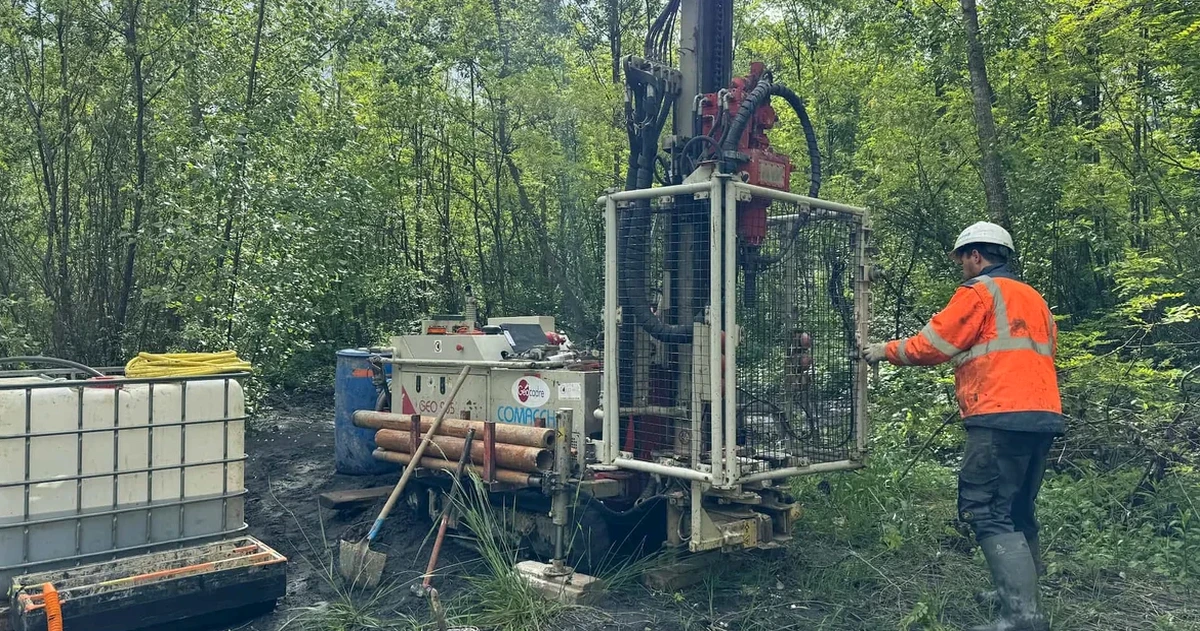
Methodology applied in Hamilton
Typical technical challenges in Hamilton
Hamilton sits about 40 metres above sea level on a floodplain that has been reshaped by the Waikato River over the last 20,000 years. That elevation figure sounds safe until you realise the water table in winter sits within 1.2 metres of the surface across much of Hillcrest and Silverdale. A soil mechanics study that skips effective stress analysis or assumes drained behaviour where pore pressures are positive will overestimate bearing capacity and underestimate settlement. The 1987 Edgecumbe earthquake (M6.5) reminded North Island engineers that distant events can shake soft ground hard—Hamilton sits on deep alluvial deposits that amplify ground motion at periods matching 2- to 4-storey structures. We run cyclic triaxial or SPT-based liquefaction screening whenever the groundwater is high and the fines content is low, because a post-liquefaction bearing failure is not something you fix after the slab is poured.
Our services
Our Hamilton soil mechanics programme is structured around the site geology first, the structural loads second. Each investigation draws on the same laboratory and field resources but is tailored to whether the ground is Hinuera sand, Taupo pumice alluvium, or interbedded peat. The four service blocks below represent the typical scope for a residential or light commercial project in the city.
Stratigraphic logging and sampling
Continuous core or split-spoon sampling across the section, logged to NZGS standard. We capture the Hinuera–pumice boundary precisely because that interface controls both bearing and drainage.
Strength and compressibility testing
Triaxial (UU and CID), direct shear, and oedometer tests on undisturbed samples. For pumiceous soils we run collapse potential assessments using double-oedometer or saturation-at-load protocols.
Chemical aggressivity suite
pH, sulfate, and chloride profiling is performed per NZS 4402. Hamilton's peaty layers can generate acidic groundwater; consequently, the exposure class is aligned with NZS 3101 for concrete durability specification.
Seismic and liquefaction assessment
SPT-based liquefaction screening corrected for fines content and energy ratio. Site class determination per NZS 1170.5, with cyclic laboratory testing when the client requires performance-based analysis.
Common questions
What does a soil mechanics study cost for a standard residential section in Hamilton?
How deep do you investigate for a soil mechanics study on Hamilton's alluvial soils?
Bore depth depends on the foundation type and load, but for a single-storey dwelling on Hinuera sands we typically drill to 6–8 metres. If soft peat or pumice alluvium is present, we extend to at least twice the estimated stress influence depth, commonly 10–12 metres, to capture the compressible layers fully.
Can a soil mechanics study determine whether my Hamilton site needs ground improvement?
Yes, that is one of its primary functions. By measuring undrained shear strength, compressibility, and collapse potential, we identify whether the native soil can support the design loads or whether techniques like preloading, stone columns, or rigid inclusions are justified.
How long does the laboratory testing phase take for a Hamilton soil mechanics investigation?
Standard strength and index testing returns results within 10–12 working days after sampling. Consolidation and triaxial suites add another week. We schedule the lab work in batches to align with the contractor's earthworks programme.