What catches a lot of people out in Hamilton is just how thick the peat layers can be, especially down around the lake margins and older river channels. You can have three, four, even five metres of highly compressible organic material sitting right under the proposed building platform. A raft or mat foundation becomes the logical choice, not because it is cheaper, but because it spreads the structural load across enough area that the underlying peat doesn’t fail in bearing or undergo intolerable differential settlement. In our experience across the city, from Rototuna to Hillcrest, a properly stiffened raft designed to NZS 3404 is the only reliable way to deliver a light commercial or medium-density residential slab without deep piling. Before committing to a thickness and reinforcement schedule, we usually run a CPT test through the suspect layers, because the continuous tip resistance and sleeve friction log tells you exactly where the transition from peat to competent alluvium sits, and that drives the raft stiffness calculations.
A raft foundation in Hamilton peat is a structural bridge that distributes load so the soil never sees a stress it can’t handle.
Methodology applied in Hamilton
Typical technical challenges in Hamilton
The most common mistake we see on Hamilton sites is a builder or a junior designer treating a raft foundation like a standard slab-on-grade and just adding a bit of mesh. That approach fails, sometimes spectacularly, when the peat compresses unevenly. Cracks open at the corners of doorways, brick veneer detaches, and services running through the slab shear off. The risk isn’t just settlement, it is differential settlement, and differential settlement in peat doesn’t happen gradually over years; it can manifest within the first twelve months if the raft isn’t stiff enough. Another failure mode that doesn’t get enough airtime is moisture cycling. Hamilton’s water table can rise and fall by more than a metre seasonally, and if the raft edge beams aren’t deep enough to stay below the zone of seasonal moisture change, you get edge heave and shrinkage cycles that fatigue the slab. In a few projects near the Waikato River we have also had to design for liquefaction-induced bearing loss in the shallow sand lenses, which requires a completely different raft stiffness calibration tied back to the liquefaction assessment results.
Our services
Our Hamilton raft foundation design work covers the full chain from subsurface investigation through to reinforcement detailing and construction phase monitoring. We do not outsource the geotechnical modelling and we don’t use generic assumptions for Waikato soils.
Raft/MAT Foundation Analysis & Detailing
Full 3D finite element soil-structure interaction modelling to determine raft thickness, stiffening rib layout, and reinforcement schedules. Output includes NZS 3404-compliant drawings, expected settlement contours, and a construction sequence that manages early-age thermal cracking risk during Hamilton’s warm summer pours.
Construction Phase Subgrade Verification
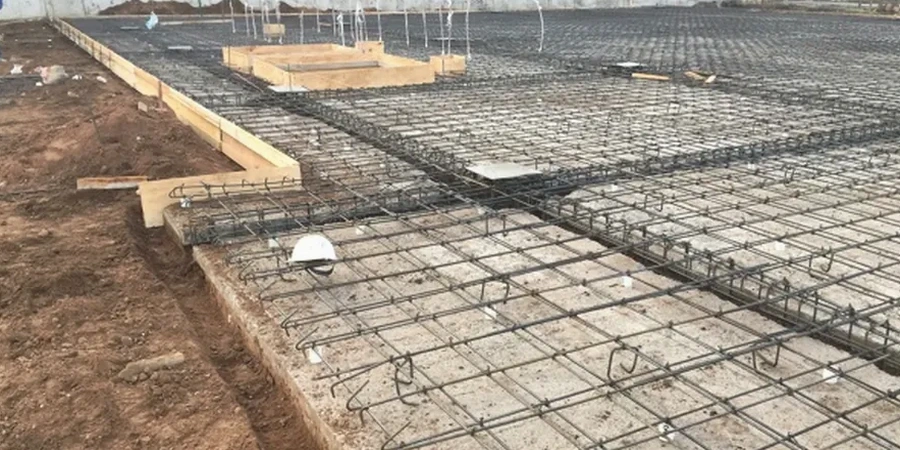
On-site inspection and plate load testing (or dynamic cone penetrometer checks) to confirm that the prepared subgrade modulus meets the design assumptions. We document each lift of engineered fill and verify that the blinding layer provides the specified capillary break before the raft steel is placed.
Common questions
Do all Hamilton peat sites need a raft, or can I use deep piles?
Not every site needs a raft, but in Hamilton it is often the most practical solution. Deep piles work too, especially screw piles or driven timber piles founded in the Hinuera Formation, but you then need a suspended floor system, which adds cost and complexity. A raft simplifies construction because it combines the floor slab and the foundation into a single operation. The decision really comes down to peat thickness: if the compressible layer is more than about 2.5 metres deep, a raft usually wins on both cost and programme.
How do you handle thermal cracking in a large raft pour in the Waikato climate?
Waikato summers are humid and often hot, which accelerates concrete setting and increases early-age thermal gradients. We specify pour sequences that limit continuous pour length, use low-heat cement blends where available, and detail crack-control joints at spacings calculated per NZS 3101. Reinforcement is designed not just for structural bending but also for restrained shrinkage: we typically run a crack-width analysis using the Eurocode 2 approach (adapted for local materials) and adjust bar diameters and spacing to keep surface cracks below 0.3 mm.
What does a raft foundation design cost for a typical Hamilton residential project?
Can you reuse an existing old raft foundation for a new building on the same site?
Sometimes, but it requires a thorough investigation. We need to expose sections of the existing raft to check concrete condition, reinforcement corrosion, and thickness. Then we run new CPTs adjacent to the old slab to confirm the soil hasn’t changed (for example, through long-term consolidation or groundwater level shifts). If the old raft is structurally sound and the new building loads are similar or lower, we can often design a strengthening overlay or a new raft directly above the old one, but this is assessed case by case.